

GREENLIGHT · AGENTIC OPERATIONS
Agentic Operations with Greenlight
Your people are the middleware. They should not be. Agentic Operations uses Greenlight to put governed agents on the work that holds processes together by hand. Agents bridge system gaps and run repeatable workflows within agreed authority. People decide the exceptions and actions that carry risk.
- Bridges the gaps between your systems and processes
- Agents run the repeatable work; people own the exceptions
- Every action explained, attributed, and auditable
Your processes don't connect. Your people do, by hand.
Someone copies the order out of one system and into the next. Someone chases the approval stuck in an inbox. Someone reconciles two records that should have matched and didn't. None of it is the job anyone was hired to do. All of it is the day.
Each of your systems owns a piece of the process. Nobody owns the space between, so a person does.
Handoffs, re-keying, checking, waiting. Invisible until something breaks.

Your best people weren't hired to be the integration layer between two systems.
You've automated before. This is the part the scripts couldn't do.
Rule-based automation handled the happy path and broke the moment a process bent. Agents reason about the exception, and the exceptions are most of the work. Our agentic AI practice establishes which parts should remain rules-based and where an agent adds value.
An agent picks up a repeatable process and runs it end to end across the systems it touches. It reads your systems of record, works out what this case needs, and carries out the action where it's cleared to. When something falls outside the rules it doesn't guess. It escalates, with the full context attached.
Agents run on an agent framework and reach your systems through the same governed context bridge as Intelligent Enterprise, grounded in your systems of record rather than a copy. The line between "run it" and "escalate it" is set per use case: confidence thresholds, explicit rules and guardrails you define.
You tune the line to the process, not the other way around.
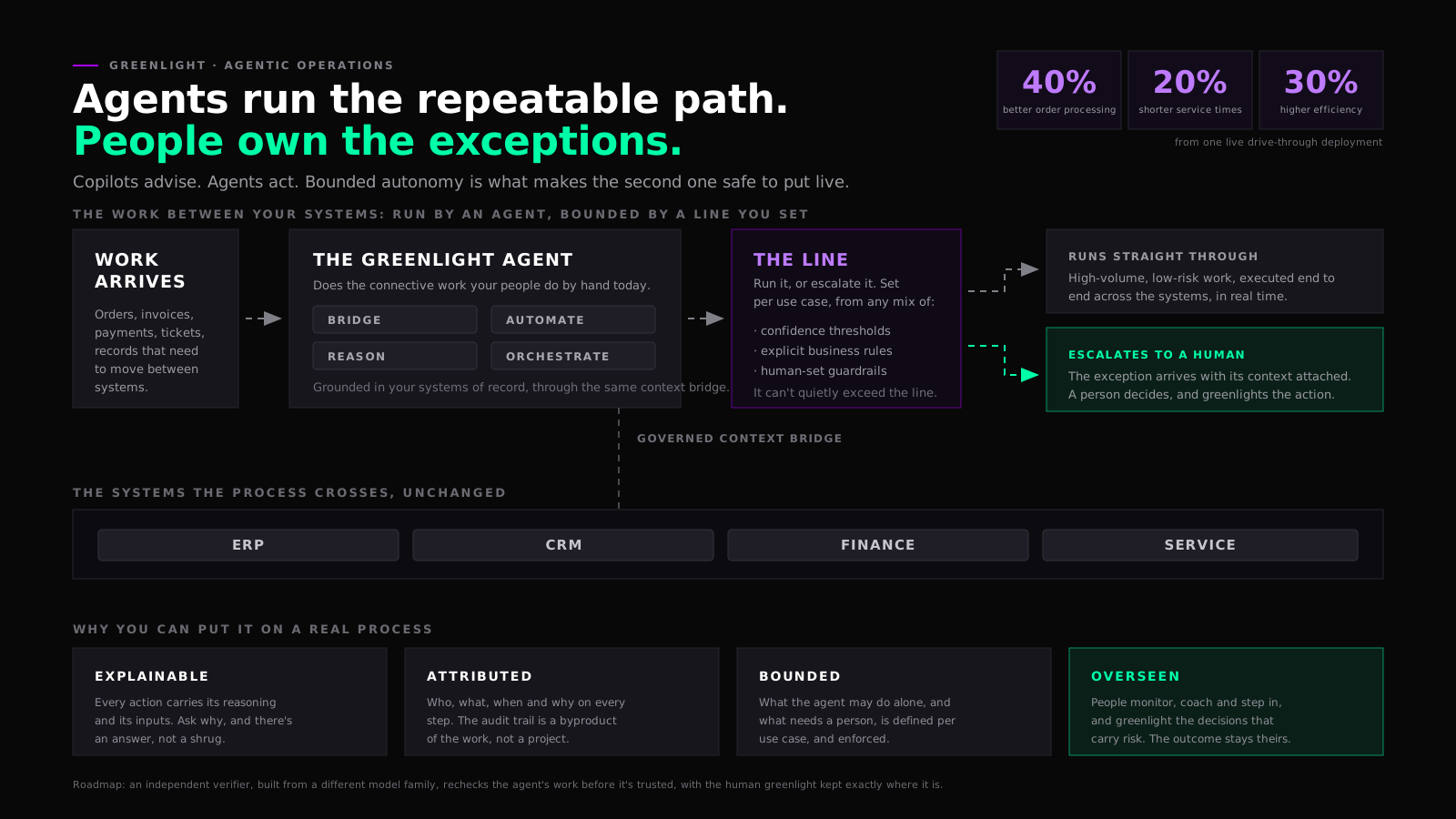
See what it did. Bound what it can do. Answer for all of it.
Agentic AI is easy to demo and hard to trust. Greenlight is built for the three things that make the difference.
 FOUR CONTROLS, ON EVERY AGENT
Every action carries its reasoning and its inputs. Ask why the agent did something and there's an answer, not a shrug.
Who, what, when, and why is recorded on every step. The audit trail is a byproduct of the work, not a separate project.
What the agent may do alone is defined per use case, from thresholds, rules, and guardrails. It can't quietly exceed the line.
People monitor, coach, and greenlight the decisions that carry risk. The human owns the exceptions and the outcome.
Not everything needs a human gate, and not everything should run unattended. The agent has room to act on high-volume, low-risk work, and a hard line it can't cross without a person. You decide where that line sits, per process.
An independent verifier rechecks the agent's work against the agreed requirements before it is trusted. It can stop the path and return the work for correction; people retain the decisions defined by the process.
Two ways to draw the run-it-or-escalate line.
These are illustrative patterns, not published client case studies. They show how high-volume, rules-heavy, cross-system work can be divided between an agent and a person. Actual scope and target outcomes are agreed against the client's baseline.
Accounts payable, run by agents
FINANCE · ERP · PROCUREMENTIn this pattern, an agent handles the accounts-payable path across finance, the ERP and procurement. It reads each supplier invoice, matches it to the purchase order and goods receipt, codes cleared items and queues them for the payment run. A price or quantity mismatch, or a payment above the approval limit, is routed to the finance team with the relevant records attached.
Matches each invoice to its purchase order and goods receipt
Codes and posts what clears, then queues it for the payment run
Reconciles supplier statements across finance, the ERP, and procurement
A price or quantity mismatch, escalated with the PO and receipt attached
Any payment above the approval limit, released by a person
Ticket triage, on a rule engine
SERVICE DESKIn this pattern, an agent reads each ticket, categorises and prioritises it against a client-owned rule set, routes it to the relevant owner and adds the context the resolver needs. Ambiguous or high-priority tickets are flagged for a person, and routing decisions can be inspected against the agreed rules.
Reads each ticket as it lands and categorises it against the rules
Routes to the right queue or owner where a rule fires cleanly
Enriches the ticket with the context the resolver needs
Anything ambiguous, flagged for a person before it moves
High-priority tickets, routed by a human who owns the call
The same model runs order-to-cash, procure-to-pay, and master-data upkeep, anywhere a repeatable process crosses systems.
An AI-assisted ordering workflow connected to live restaurant operations.
A QSR giant uses an AI assistant in the live drive-through workflow. Hungry Jack's identifies Hi Auto as the provider of the technology that powers the assistant. Softobiz supported the integration, data and operational engineering around the initiative.
The assistant works with crew members, and customers can request a person at any point in the ordering interaction.
The assistant operates within a defined ordering path while crew members remain available. The same operating principle applies wherever an automated workflow needs an explicit human boundary. Read the drive-through integration story
Not another autonomous-agent promise. A governed one.
Most of the market sells agents on autonomy: "runs on its own," "set it and forget it." For a process that touches your ERP and your money, unbounded autonomy is a risk, not a feature.
Greenlight sells the opposite: agents with real range and a hard governance line. They do the repetitive coordination your people shouldn't, and they stop at every decision that carries risk so a person can own it. Ongoing evaluation and control can continue through our [AI managed services](/ai-managed-services).
Before agents run part of your operation.
Start with a repeatable workflow that crosses systems, has an accountable owner and has clear rules for when a person must intervene. We assess the available interfaces, data and operational risks before setting the scope.
The permitted actions are agreed per process. Routine work can run within defined rules and thresholds. Ambiguous cases, exceptions and actions above the approval limit go to a person with the relevant context.
An independent verifier rechecks the agent's work against the agreed requirements. This supplements the process guardrails and human approval; it does not guarantee that every error will be detected.
Not necessarily. Rules remain useful where decisions are explicit and predictable. We assess where agents can add coordination or interpretation, and where existing rules and human judgement should remain in control.

Find the process where your people are the middleware, and take it off them.
Book an AI governance and readiness assessment. We map your operations, find the repeatable functions where governed agents pay back fastest, and show you what that's worth before you commit to scale.